Journal
Putting a scratcher where the cat already rubs
October 17, 2026 · 5 min
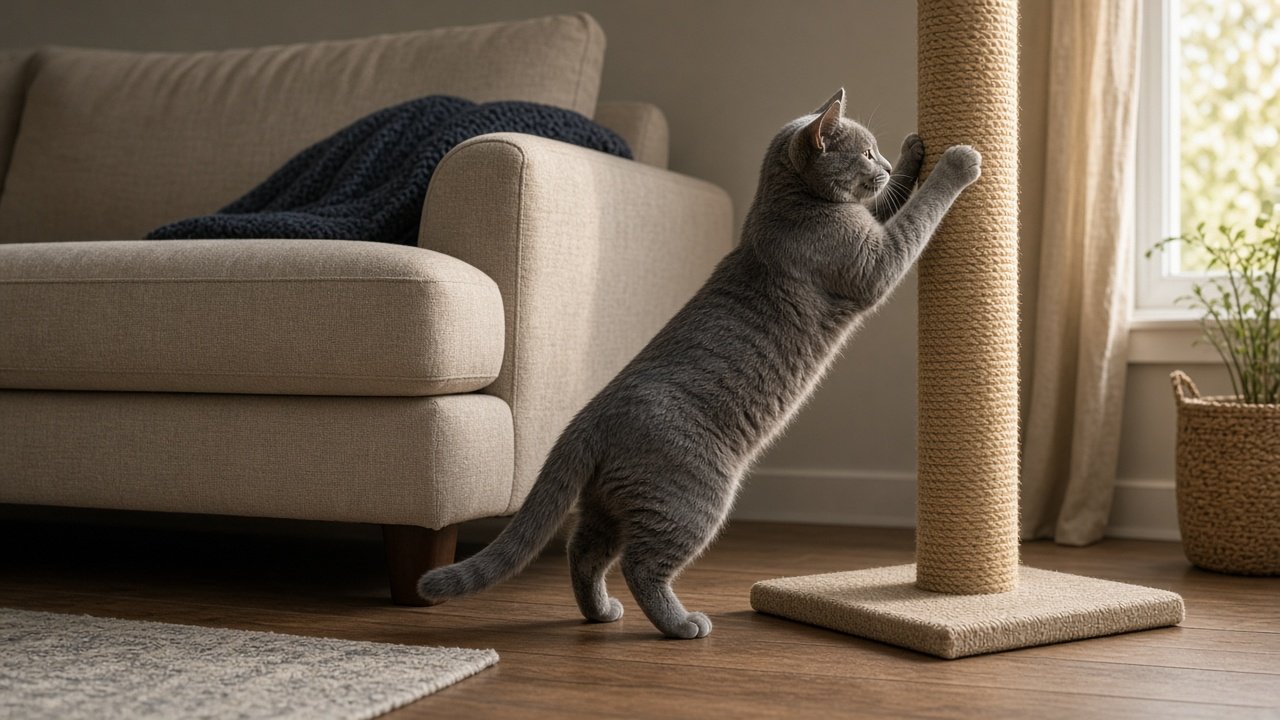
As autumn days shorten, a cat spends more hours on the same indoor path. The useful change is to put a scratcher on that path — where the cat already rubs — not to diagnose the sofa.
This is placement. It is not a behaviour clinic, and it is not a reason to decide what the scratching “means.” Cats scratch to condition claws and to leave a mark on a vertical or horizontal they already use. When indoor time rises, that mark often lands on the nearest tall thing. Move or add a scratcher there. The Cats collection is the shop side of indoor kit; this note does not pick a model.
Shorter days, the same hallway
From late afternoon the house is the whole territory. The path from the sleeping chair to the window, from the litter room to the food bowl, from the radiator to the back of the sofa, gets more traffic. A scratcher in the spare room does no work if the cat does not walk through the spare room.
Watch for two or three days without rearranging the furniture. Notice where the cat stretches up, where the claws catch, where the face rubs on a corner. That is the map. You are not looking for a motive. You are looking for a coordinate.
Follow the rub, not the upholstery lecture
If the cat already works the right-hand arm of the sofa, the scratcher belongs beside that arm, or in front of it, close enough that the first stretch meets sisal or cardboard instead of fabric. A post across the room is a second address. Most cats will not cross the rug to be correct.
If the work is on a door frame, put the post at that frame. If it is on a low ottoman, a horizontal pad or a low ramp on that exact side of the room is the honest answer. Do not punish the furniture in writing here, and do not decide the cat is anxious, angry, or bored. Those are diagnoses this page will not make.
Height and angle on a path you already know
Match what the cat is already doing. A full vertical stretch wants a post the cat can reach without hopping onto a shelf. A long rake along the floor wants a flat or slightly inclined surface the cat can stand on. You do not need a catalogue of types. You need the angle that is already in use, placed on the path.
Stability matters more than height bragging. A post that rocks will be left. If the base slides on hardwood, a heavier base or a quiet corner against a wall is enough. We do not publish tests or ratings. If a piece you already own still stands, keep it and move it.
One more post is often the whole change
You do not need a ring of scratchers. You need one obvious option on the busiest path, and sometimes a second where the cat already has a second habit — a bedroom door, a window perch. Two well-placed surfaces beat five in unused corners.
If the household also has a dog, keep the scratcher where the cat can use it without being trotted through. That is still placement: a side of the room the dog does not use as a racetrack. It is not a statement about the animals’ relationship.
What this note will not explain
It will not explain spraying, hiding, or a sudden change in appetite. It will not tell you the cat is stressed because the days are shorter. It will not tell you to cover the sofa in foil or to scold. If the cat is injured, limping, or the scratching is frantic and new in a way that worries you, that is a veterinarian, not a rearrangement.
Carrier practice, if you need the box later in the season, stays with the process of leaving the carrier out — and model choice stays with the cat carrier guide. A scratcher is not a carrier problem.
A small house change, then leave it
Move the post. Live with it for a week before you move it again. Cats use what stays. If you keep sliding the scratcher to “try the other wall,” you are teaching them there is no address. The sofa arm will still be there.
In a tight apartment the same rule holds: the path is shorter, so the post has to sit on it, even if that is visually imperfect. The apartment guide is about living with animals in small rooms. It does not replace this coordinate.
After the post is on the path
You can pick loose fibres off the sofa if you want a tidier room. That is housekeeping. It is not a verdict on the cat. If you look at the shop, look at Cats for a post you already decided to add — not because a journal promised a cure. There is no cure on this page. There is a piece of furniture in the right square metre.
Placement, not a theory
- Watch the real path for a couple of days.
- Put a stable scratcher on the rub, at the angle already in use.
- A second post only where a second habit already exists.
- Leave it a week.
- Injury, limp, or a change that worries you — a veterinarian, not this article.