Journal
When a light jacket goes over a walking harness
October 1, 2026 · 6 min
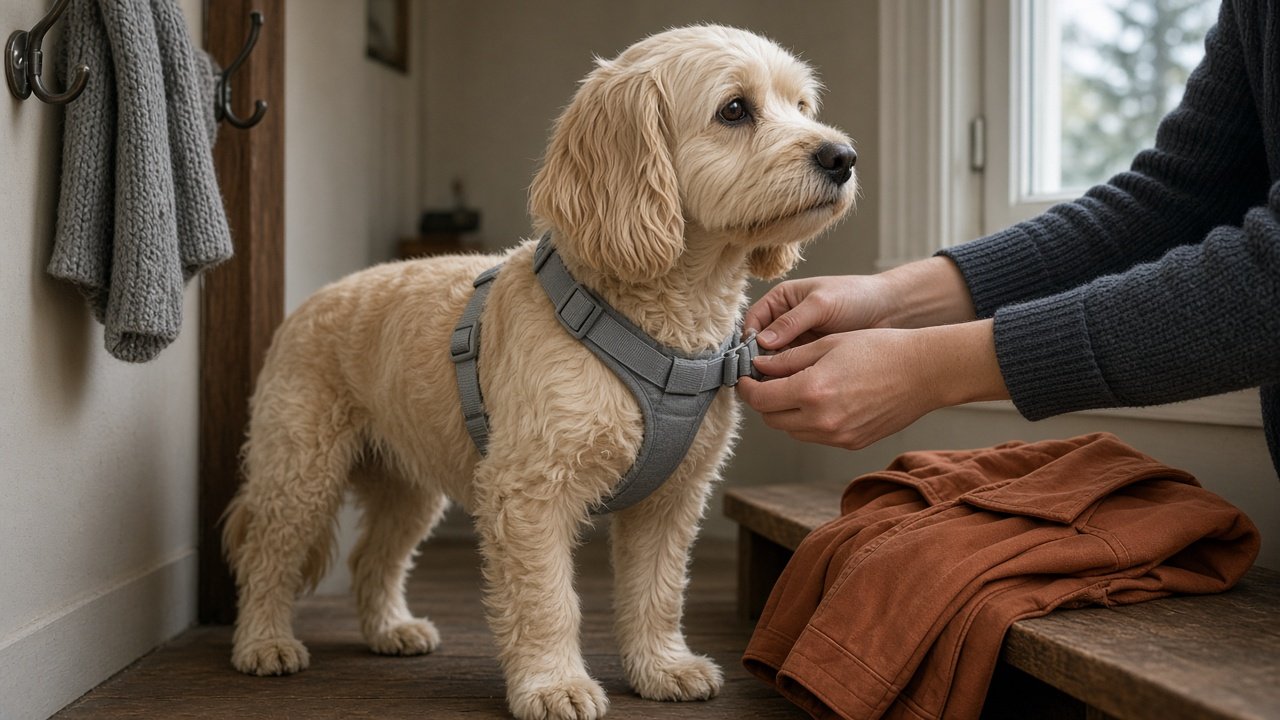
A light autumn jacket over a walking harness is a hardware problem: you still have to reach the clip, and the straps still have to sit where you left them. If you cannot operate the buckle with the jacket on, the layer is in the wrong order — or it is the wrong walk for a jacket.
This is not a coat-shopping note and not a first-time measuring lesson. Length, chest, and neck still belong to how to measure a dog for a harness. Warmth, coverage, and whether the dog needs a coat at all stay in the winter coat guide. What follows is only the stack: jacket, harness, lead, hands that are often wet.
The problem is reach, not appearance
You put a jacket on because the dog looks cold, or because the wind on the corner is sharper than it was in September. Then you cannot find the D-ring. Or you find it, clip, and the jacket has ridden back so a strap now sits on the throat. Or you can clip, but you cannot unclip at a busy curb without peeling the jacket up like a shirt.
Those are the failures that matter on an October sidewalk. Colour, brand, and “looks warm” do not. If the lead attaches on the back, the jacket needs a gap, a zip, or a hem short enough that the ring stays a ring. If the lead attaches at the chest, the jacket cannot bury that buckle under a placket you need two hands and a quiet hallway to open.
Try the stack in the house before the walk. Put the harness on as you already wear it. Add the jacket. Clip the lead you actually use. Walk to the door, unclip, clip again. If that sequence needs a second person, it will not work in rain.
Dress in an order you can undo
Two sequences exist. Harness first, jacket over: common, and fine if the clip remains reachable and the jacket does not shove the straps. Jacket first, harness over: useful when the jacket is a thin shell and the harness is the piece you want to adjust without undressing. Neither sequence is a rule. The rule is that you can reverse it with one hand on the dog and one hand on the hardware.
If you always do harness-then-jacket because a photo showed it that way, notice whether you then fight the zipper around a back ring. A short unzip at the shoulders, or a jacket that stops before the ring, is often enough. Do not cut holes in a coat. If the garment cannot coexist with the clip, leave it on the hook for this walk.
Collars can stay on for ID. The walking connection is the harness clip you planned to use. If you are still deciding collar versus harness as a system, that comparison lives in the collar or harness guide, not in a layering paragraph.
What fabric does to a buckle
Soft shells slide. Quilted fabric bunches. A knit “sweater” drags a neck strap forward when the dog lowers a head to sniff. You will see the fit change without anyone loosening a buckle. That is why a jacket can make a correctly fitted harness feel suddenly tight or suddenly crooked.
After the jacket is on, run two fingers under the straps that matter: the one behind the elbows, the one across the chest. You are checking that fabric did not steal the slack you already set. You are not re-measuring the dog. If the strap has nowhere to go because the jacket filled the space, the jacket is too bulky for this harness, or this harness is the wrong silhouette under cloth. Do not keep adding holes. Take a layer off.
Wet fabric grabs hardware. A plastic buckle that opens easily in the kitchen can fight you at the corner. Practice the release at home with the jacket damp from a sink if you have to. Better to discover a stuck clip in the hallway than in a bike lane.
Clip points that stay usable
Know which ring you intend to use before you leave. Back clip for a steady walker. Front clip if that is already how you manage pulling — and only if you can still reach it. Switching rings because the jacket hid one of them is how people end up with a twisted chest strap and a dog who cannot turn.
The Harbour Walk Harness is one of the walking harnesses in the shop. We do not claim a jacket-specific fit for it or for any other harness. If you buy a new harness because the old one vanished under a coat, measure first using the measuring guide. Do not guess a size from a jacket size. Those numbers are not the same thing.
Leads belong in the hand you trust when the jacket zipper is also in that story. The leash guide covers length and grip. A lead you can shorten still matters when a jacket makes the dog a wider, rustlier shape on the sidewalk. The Walk collection is where those pieces live.
When the jacket stays on the hook
Leave it if you cannot reach the clip. Leave it if the dog overheats on the first block — panting, slowing, looking for shade on a mild day. Leave it if the garment twists and rubs a bare armpit. This article will not give you a temperature at which a dog “needs” a coat. That kind of rule is how people overdress a husky and underdress a sighthound, and we will not invent one.
A light autumn layer is optional. The walk is not. A dog who already has coat enough for a cool Canadian morning can go out in harness alone. If you are choosing a winter coat for ice season, stop here and open the coat guide. Shopping from this page would be the wrong list.
Puppies and seniors sometimes want a layer earlier. That is an observation you already have. If shivering at the door is new, or the dog refuses to walk, speak to a veterinarian.
Two minutes at the door
- Harness on as usual. Check the straps you already know.
- Jacket on, if you are using one. Find the ring with your eyes, then with a gloved hand.
- Clip. Take three steps. Unclip and clip once more.
- If any of that failed, jacket off. Walk anyway.
Do this facing the door, not in the living room after the dog has already decided the walk started. The stack that works is the stack you can rebuild when you are late.
What you are not doing here
You are not sizing a first harness from a coat chart, comparing winter coats, or rating waterproofing. Creature & Kin does not publish those tests.
If the harness itself no longer fits, go back to measuring. If the dog is actually cold in true winter, use the coat guide and the Winter collection. October layering is a reach-and-order problem. Keep it that small.