Journal
A ten-minute look at the lead and harness you already own
October 16, 2026 · 5 min
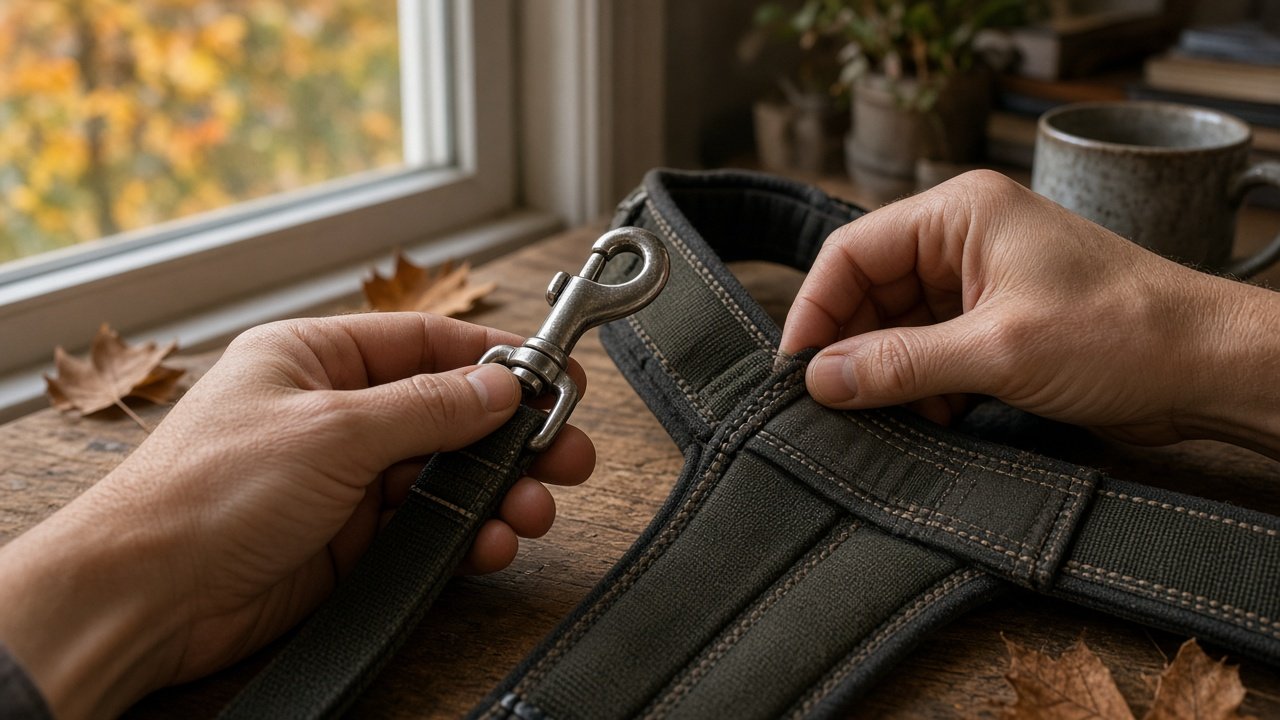
Before the first frost, take ten minutes with the lead and harness you already own. Look at stitching, the clip, and the fit. Frost is a poor morning to discover a tired piece of hardware. This is not a lesson in walking on ice, and it is not a coat list.
Ice, salt, and how to move on winter sidewalks stay with the winter walking guide. Whether the dog needs a coat at all stays with the winter coat guide. Today you are only asking whether the kit on the hook will still close and hold when the air bites.
Frost is a deadline for hardware, not a shopping season
A clip that has been opening all summer on damp grass will open in January too — or it will not. Webbing that has sat against a wet jacket, then dried on a hook, can fray at the edge you never look at. Ten minutes in mid-October is cheaper than a scramble on the first hard morning, when you also have gloves and a shorter clock.
You do not need a workbench. You need the lead and harness in daylight, your hands, and a willingness to retire a piece that fails the look. The Walk collection is there if something must be replaced. It is not a reason to replace what still works.
Stitching and webbing you can see
Run a thumb along the edges of the lead and along every stitched junction on the harness: chest, girth, the tab that holds the ring. Look for thread that has pulled, a fold that has worn through, or webbing that has gone thin and shiny at a buckle. Check the underside, where the dog’s movement rubs.
If a stitch line is open, or you can tease webbing apart with a fingernail, that piece is done. Do not sew it as a weekend project and call it walking gear. Do not wrap tape over a fray and keep using it near a road. Hang it off the hook and use the spare if you have one. If you do not, you are shopping for a replacement, not a repair kit from a journal note.
The clip still has to close
Open and close the snap or carabiner several times. It should seat with a clear action and stay shut when you tug along the line, not only when you hold it pretty. Look at the gate for a bend, a gap, or grit packed in the spring. Rinse grit under a tap and dry it; if the gate still sits open or feels gritty after that, retire the clip.
A lead is only as useful as that closure. If you are choosing a new everyday length, the leash guide is the place for hand feel and length, not this inspection. The Day Lead is one lead in the shop. We do not claim frost ratings or a breaking load for any clip.
Fit after a season of use
A harness that fitted in June can sit differently in October. The dog may have changed shape. The webbing may have slackened at the sliders. Put it on. You should still be able to slide two fingers under the girth without a gap you could push a fist through, and the chest piece should not ride up into the throat when the dog looks up.
If you are no longer sure of the numbers, measure again before you buy another size: how to measure a dog for a harness. The collar-or-harness note is for the hardware choice, not for ice. The Harbour Walk Harness is one walking harness in the shop. We do not claim a winter fit or a weather spec.
What you do not decide in these ten minutes
You do not decide how to walk on ice. You do not decide a boot. You do not decide a temperature at which the dog stays in. You do not decide a coat from the fact that the mornings are cooler. Those sentences, when they become real, live in the winter guides and in the Winter collection. This page stops at “will this clip still close.”
You also do not invent a night feature. Reflective trim that is peeling is worth noticing; it is not a rating. If the evenings are already dark, visibility is a dusk-walk problem, not a frost-inspection problem. The evening-walk note holds that routine.
If something fails the look
Take the failed piece off the door hook so nobody grabs it on a dark morning. Use the spare. If there is no spare, you walk on a known short loop with whatever sound piece remains — a collar and a sound lead, if the harness is the failure — until the replacement arrives. Do not pair a tired clip with a longer outing “one last time.”
Quebec public-leash rules still apply as the season turns: 1.85 m in a public place, and a harness or head halter for dogs 20 kg or more, unless a local rule says otherwise. An inspection does not change that. Source: Gouvernement du Québec, Encadrement des chiens.
Ten minutes, then hang it back
If the stitching holds, the clip seats, and the harness still fits, hang the kit where the walk starts. You have done the autumn job. When the puddles skin over, open the winter walking guide. Do not stretch this checklist into ice advice.
Most kits pass. The value is the few that do not, found on a mild afternoon instead of at the curb on the first frost.
The look, in order
- Daylight on the lead and harness, both sides of the webbing.
- Stitch lines and worn edges; retire an open seam.
- Clip open, closed, and tugged; retire a gate that will not seat.
- Harness on the dog; measure again if the sliders have gone vague.
- Failed pieces off the hook. Ice and coats stay in other guides.