Journal
After rain: roots, boardwalks, and a shorter line
October 13, 2026 · 6 min
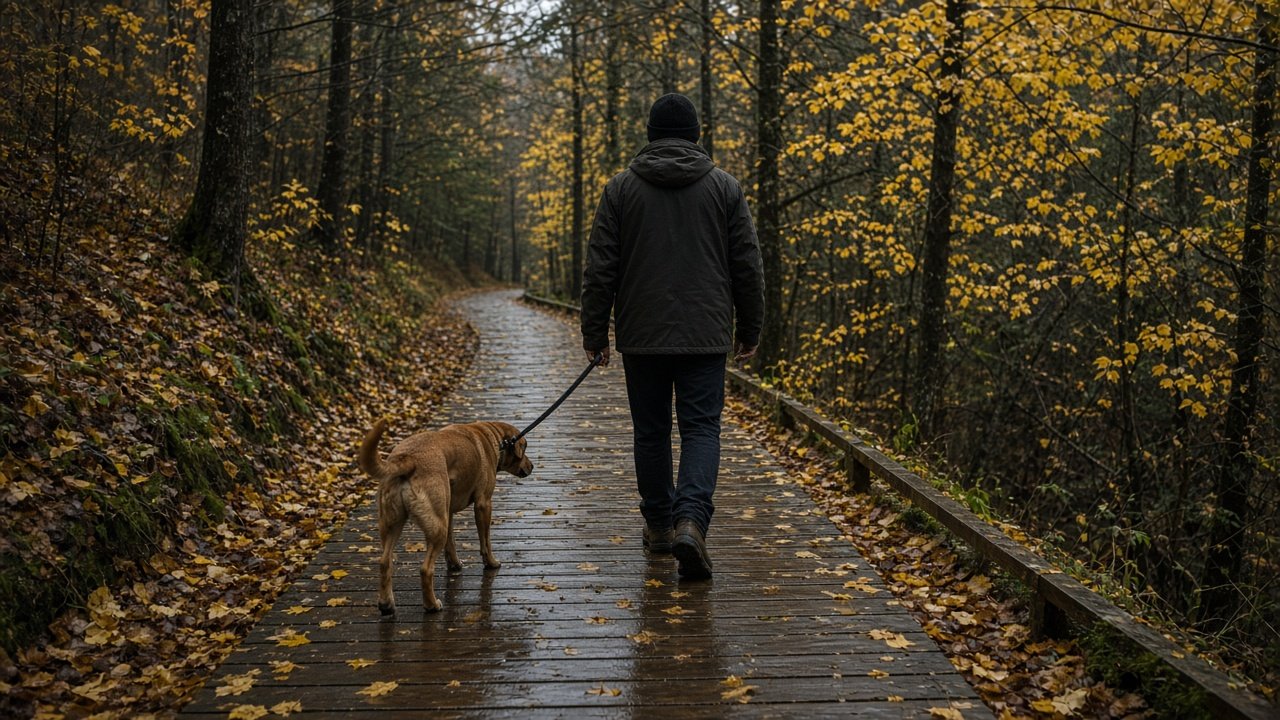
After rain, a trail walk with a dog is a footing problem: wet boardwalks, slick roots, and a line short enough that the pair stays on the tread. It is not a wet-sidewalk loop, and it is not ice.
This note is for same-day autumn hours on a marked path — a conservation area, a ravine trail, a park loop with wood and clay. A neighbourhood walk on pavement you already know is a different outing. Packed snow, ice, and road salt belong to the winter walking guide, not to this afternoon.
The trail is not a wet sidewalk
On a sidewalk you can usually see the next curb. On a trail after rain, the next step may be a root, a slick plank, or clay that holds a print. The dog will want the ditch, the puddle, and the smell in the brush. You want the pair on the worn line where other feet have already packed the mud.
Slow the pace before you shorten the day. A shorter, slower loop on the path you can see is more useful than a long push through a section you cannot read. If the lot is already a sheet of water and rain is still coming down, choose known pavement instead and leave the trail for a drier morning.
Roots, planks, and clay that holds
Boardwalks and wooden bridges stay slick after the sky clears. Treat them as a crossing, not a place to let the dog swing wide. Roots that were grippy in August become rounded and wet. Clay packs into the tread and into paws; that is a mess at the door, not a reason to leave the path and walk the vegetated shoulder.
Painted markers, metal grate steps, and wet rock near a creek behave like the slick bits of a city walk, only with farther to fall. Gather the line before those surfaces, not after the first slip. This is autumn moisture on wood and mineral. It is not frost. When the ground rings and the puddles skin over, stop using this article and open the winter note.
Stay on the tread you can see
Widening around a puddle feels polite to your shoes and hard on the trail. The worn centre is there so the rest of the corridor can hold plants, and so the next walker is not surprised by a dog in the brush. Stay on the marked line. Do not cut switchbacks. If a board is closed or a section is roped, turn around rather than inventing a bypass through wet understory.
Park and conservation rules vary. Some trails ask for a leash the whole way; some close a section after rain because the tread fails. Read the board at the lot. In Quebec, public-leash rules still apply on many paths: a maximum length of 1.85 m in a public place, and a harness or head halter for dogs 20 kg or more, unless a local rule says otherwise. Source: Gouvernement du Québec, Encadrement des chiens.
Wildlife still uses the corridor
After rain, animals move on the same packed line you do. A rustle in wet leaves is not an invitation to investigate. Keep enough space that a dog cannot lunge into the verge. If you cannot see around the next bend, shorten the line before the bend, not after a deer or a cyclist is already committed.
Other dogs on a narrow, muddy path have less room to pass. Step to a pad of gravel if there is one; otherwise pause, shorten, and let the other pair through. Off-leash greetings in a dripping ravine are hard to read and harder to unwind. Waiting on a rock costs less than an argument in the plants.
Gather the line before the slick bit
A long or retractable lead lets a dog reach the creek, the boardwalk edge, or another walker before you can collect them. On a wet trail, the useful length is the length you can gather in one motion. If you are choosing or replacing that lead, the leash guide covers everyday length and hand feel. The Walk collection includes the Day Lead.
A fitted harness can make a short-line descent easier to manage than a collar if the dog pulls on a slope. Measure first: how to measure a dog for a harness. The collar-or-harness note is the place for that hardware choice. The Harbour Walk Harness is one walking harness in the shop. We do not claim trail-specific grip or weather ratings for any piece.
Turning around is part of the outing
If you cannot see the next root, if the boardwalk runs with water, or if the dog is already sliding, the useful decision is to go back the way you came. You do not owe the trail a full loop. A shorter return on ground you already crossed is still a walk.
If daylight is already thin at the lot, treat the trail as a dusk problem as well as a wet one. The evening-walk note on shorter days is about visibility and a known route; a dripping ravine is a poor place to learn that lesson. Source for clock-change timing if you are planning weekend hours: National Research Council Canada, Time zones and daylight saving time.
What this walk does not decide
It does not decide a coat. It does not rate boots. It does not name a temperature at which to stay home. Those questions, when winter actually arrives, sit with the winter walking guide, the winter coat guide, and the Winter collection.
If paws come back cut, a pad is torn, or the dog will not bear weight, stop and speak to a veterinarian. A shop article does not treat that. Mud and leaf litter at the door are a house problem for later. The trail problem is only the line, the tread, and the pace.
Before you leave the lot
- A lead you can shorten in one motion.
- ID on the dog, and a phone that still has battery after the trees.
- A plan to stay on the marked tread, including a turnaround point.
- Time to finish in the light you actually have.
- A place at home to deal with clay — not a second trail.